
When today’s skills become yesterday’s assets: towards predictive talent management





Can we recruit for skills that do not yet exist?
How can we assess the potential of an employee whose role is likely to change over the next two or three years?
What reference points can we rely on when skills frameworks themselves are being rewritten?
These are the real questions HR professionals are facing today. And they call for more than an updated job description.
Technical skills have an expiry date
For a long time, recruitment meant looking for the right experience, the right degree, the right number of years in the right industry. A clear CV, a coherent career path and a good impression during the interview.
This model was reassuring. It was also built for a stable world.
Today, roles are becoming increasingly hybrid. The boundaries between functions are blurring. A technical skill once considered essential can become secondary in less than two years, accelerated by generative AI, digital transformation or simply the evolution of organisations.
In this context, relying solely on what someone can do today means hiring for the past.
Soft skills as a foundation
What withstands change is not technical know-how. It is behavioural skills: learning agility, adaptability, emotional management, collaboration under pressure and resilience in the face of uncertainty.
These skills cannot be improvised, nor can they be acquired in just a few weeks. They are long-lasting, transferable and predictive of long-term success, regardless of the role.
The real question is therefore no longer only: “What can this candidate do?”
It is: “What can they become? How will they evolve? In which contexts will they truly perform?”
From assessment to prediction: why Central Test is becoming Key Predict
In the early 2000s, online psychometric assessment opened up a new field of possibilities. It still had to prove itself, demonstrate its reliability and establish itself as a credible method for supporting HR decisions.
Twenty-six years later, the subject has taken on a new dimension. Usage has changed, organisations’ expectations have evolved, and the question is no longer only how to assess talent, but how to make intelligent use of the data collected.
Because while assessment remains essential, it can no longer be an end in itself. Today, companies must navigate more complex environments: an increasing number of HR tools, data often scattered across recruitment, mobility and development, sometimes limited visibility over talent, and a persistent difficulty in translating results into concrete decisions.
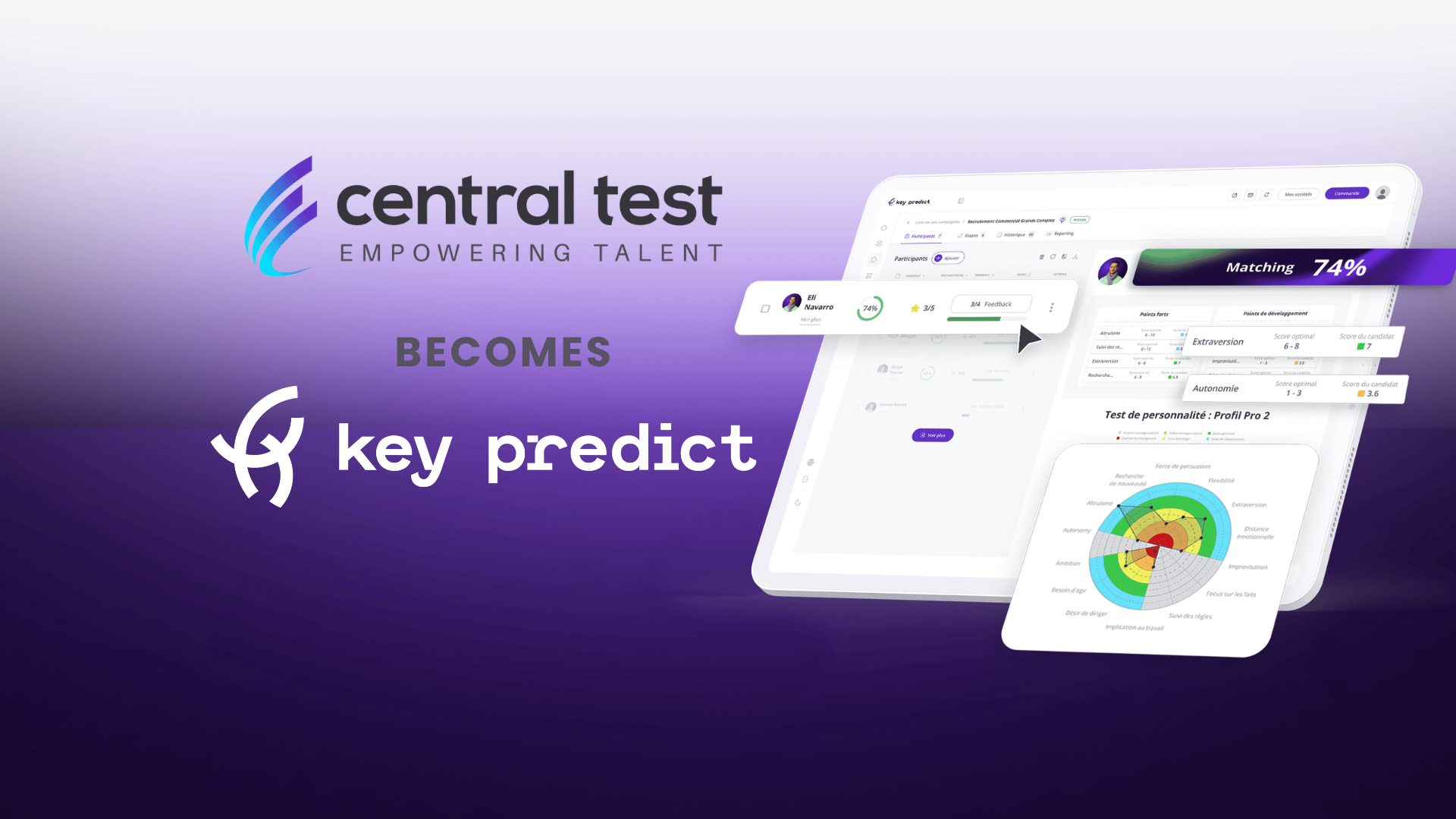
It is in this continuity that Central Test is becoming Key Predict.
This evolution is not simply a change of identity. It reflects a broader ambition: to help organisations connect their data, project it over time and better manage human potential as a whole — from recruitment to development, from mobility to retention.
Assessment alone is no longer enough to meet today’s challenges. Organisations need to link data together, project it into the future and transform results into concrete decisions across the entire talent lifecycle: recruitment, development, mobility and retention.
A vision built on three pillars
Key Predict embodies a renewed approach to talent management, faithful to the values that shaped Central Test and enriched by the opportunities now offered by technology and data science.
Science remains at the heart of the models: validated psychometric tools, international methodological standards and a multi-criteria approach form the foundation of every assessment.
Predictive technology makes it possible to go further: explainable and responsible AI, designed to inform human decision-making without replacing it, with recommendations that remain understandable for HR teams and managers alike.
People remain at the centre of every journey, whether HR professionals, managers or the talents themselves. The aim is not to automate decisions, but to give organisations the means to anticipate, understand and act with greater accuracy.
This change of name reflects a conviction shared with many HR professionals: companies no longer only need to assess. They need to predict, project and make sustainable decisions, based on solid methodologies and technology that serves people.
With Key Predict, a new stage in talent assessment is beginning — one where data becomes a strategic lever in the service of people and organisations.
An exclusive webinar, “From assessment to prediction: Central Test becomes Key Predict”, will be held on 04 June at 10:30 a.m. to present the vision, key features and next steps of this transition in detail.