Applications in recruitment and cognitive assessment
Identify candidates capable of visualising, designing and solving spatial problems.
Develop visual thinking skills required in technical or creative roles.
Assess spatial abilities in admissions processes, especially for STEM or creative programmes.
What the Reasoning – Spatial test measures
Mental rotation: ability to visualise, transform and manipulate objects in 2D and 3D. This ability enables individuals to:
- Understand complex spatial structures
- Anticipate visual transformations
- Solve problems based on mental representations
It is particularly valuable in fields such as architecture, design, engineering and creative industries.
What sets the Reasoning – Spatial test apart
- Targeted assessment of mental rotation
- Short and efficient format (8 questions)
- Engaging and innovative visual exercises
- Comparison between STEM and non-STEM profiles
- Integrated into the Talent Map and predictive model
Results & Reports
Ready-to-use actionable reports
Individual report
- Overall spatial reasoning score
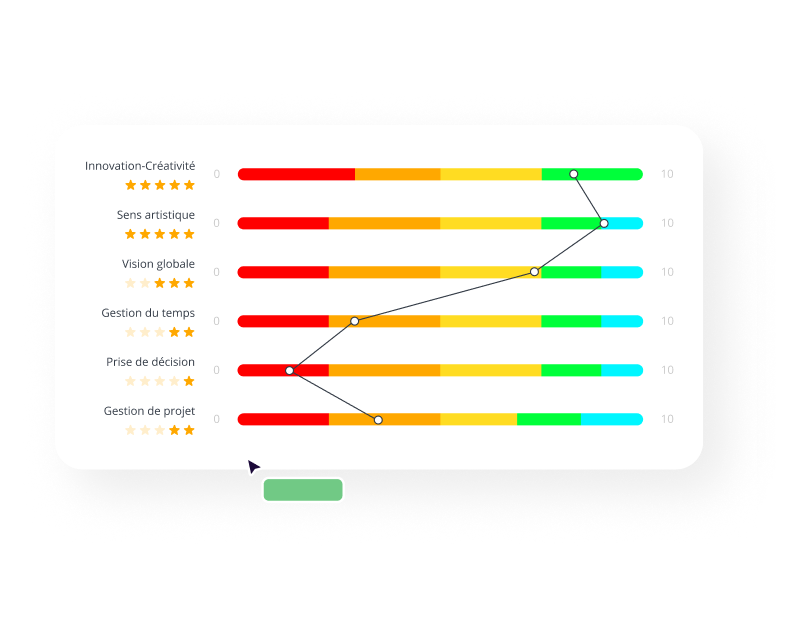
- Performance visualisation
- Clear definition of assessed abilities
- Personalised comments and interpretation
Insights report
- Mapping of spatial abilities in the Talent Map
- Predictive matching with roles requiring strong visual skills
- Use in Talent Matcher campaigns (technical, creative or STEM roles)